For most website owners, bounce rate is a red-flag for their business growth because a high bounce rate badly affects a website SEO. Even if you follow a strong SEO strategy to attract people if they leave without interacting with your site, your efforts go in vein.
Bounce rate shows the percentage of visitors who leave your site without any engagement like clicking on links, scrolling, or signing up etc. It clearly indicates user dissatisfaction on your website. If you are also stressed due to a high bounce rate on your website, don’t worry, you can significantly reduce it with simple steps.
In this article we have shared some result-driven effective ways to reduce bounce rate on your website along with the main causes of having a higher bounce rate so that you can work them to improve.
What is bounce rate?
The term “bounce rate” of a website refers to the digital marketing metric that shows the percentage of visitors who leave a specific site just after viewing one page without involving in any activity like scrolling through the page, clicking on any link etc.
A website bounce rate generally signifies poor content relevance, user experience, and site performance. To generate the bounce rate, you need to calculate the ratio of single page sessions to total entrances.
For example, if 100 people visits your website, and 20 people leave after viewing one page without taking any action, the bounce rate of your website is 20%. It indicates a good amount of user engagement. A higher percentage means your website needs improvement.
To reduce your website’s bounce rate, you must understand the causes of it. Let us find out some of the most common causes of high bounce rate.
Causes of high bounce rate?
Before you take any steps to reduce bounce rate, you need to check a few things like, your site speed, if it is too slow, if the content is relevant, or if your site does not perform well on mobile devices, etc. In simple words, you need to review your site before gearing up to improve it.
Here are some of the main causes of a higher bounce rate on your website:
- Poor site performance: Websites that have slow loading time indicates poor Performnce. As visitors are impatient, they don’t take more than a few seconds to turn to your competitors.
- Irrelevant content: Your website content plays a crucial role in attracting and keeping your visitors glued to your site for long. If the content does not suit with the ads, or there are issues with the language, meta description, or information, users instantly switch to another website.
- Lack of mobile optimization: Most websites are viewed on mobile devices so if your website does not adjust to different screen sizes or it shows broken or incomplete images or content in mobile devices then it needs immediate improvement because this could be the biggest reason behind your poor bounce rate.
- Poor navigation: If your website links do not redirect to the right page, users struggle a lot to find what they are looking for on it. As a result they leave the site without an action increasing your bounce rate.
7 ways to reduce bounce rate on your events website
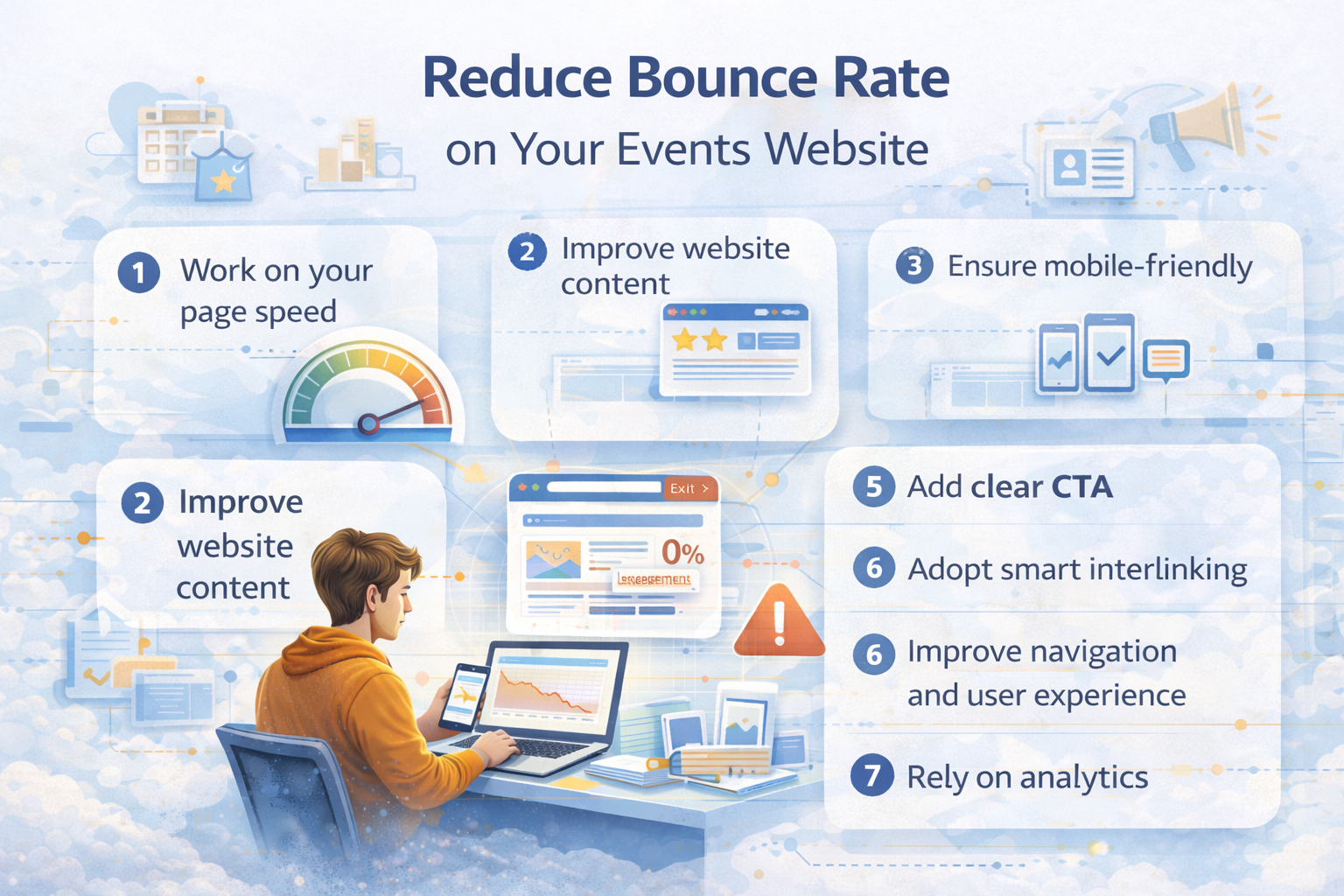
Here are some effective ways to reduce bounce rate on your website:
1. Work on your page speed
When it comes to reducing bounce rate, you should always start with tracking your page speed. Google says, almost 53% of users leave a site if there is a delay of 1 second in loading. As human attention span is getting shorter, your website speed remains as the most important factor for its performance.
Consider the following tips to improve your page speed:
- Start with tracking your page loading speed with a tool like Google page speed insights.
- Ensure that your website strictly uses responsive designs.
- Compress large images without affecting their quality.
- Enable browser caching so that your visitors’ browser remember a few things about your website whenever they visit it for the first time including its logo, navigation menu etc. This ensures that when they come to your site for the second time, their browser does not need to load everything from scratch.
- Choose the right hosting that allows you to check your server response time.
2. Improve website content
The second thing that needs improvement to reduce bounce rate is your website content. So you need to choose your words wisely for your website content because it is the only way to communicate with your visitors. You need to make sure that your visitors get what they want on your website through the content.
Consider the following tips:
- Ensure that the content you publish perfectly align with your user intent.
- Make your content powerful with an attractive introduction that talks about audiences’ problems and how you can solve them.
- Use easily understandable language and short paragraphs.
- Add relevant content by focusing on the pain point of your customers or audiences and their solutions.
3. Ensure mobile-friendliness
Creating mobile friendly websites is an absolute necessity for business owners as research says more than 90% users prefer to access websites through their mobile devices.
Consider the following tips to make your website mobile friendly:
- Use mobile friendly website theme that offers responsive designs.
- Add WordPress plugins to your website that are optimized for mobile devices like WP Event Manager.
- Make sure to use the right font size and style that would look good both in mobile and desktop.
Remember, if your site is not mobile optimized, then you are missing out a large number of users.
4. Add clear CTA
Having clear CTA buttons are essential to reduce bounce rate on your website. It guides your website visitors on what to do next. Users simply feel lost when do not find the CTA button after landing on your website.
Here are some tips to improve the position of your CTA button:
- Add your CTA button in place on your website that grabs maximum attention like at the top, or under an engaging content.
- Use prominent fonts and colors to attract eyes.
- Check the button before going live to ensure that it redirects to the right place.
- Use action driven words like “Learn more”, “Get started” etc.
5. Adopt smart interlinking
One of the best ways to encourage your website visitors to spend more time on your website and reduce bounce rate is to add internal links to various content. You can add relevant links to various pages on your website to your blogs to guide users on various topics. It simply gives them a reason to visit more pages.
- Interlinking increases page views.
- Offers better understanding on relevant topics to website views.
- Creates a smooth navigation flow.
6. Improve website navigation and user experience
To reduce bounce rate, you need to ensure that you use intuitive navigation on your website.
Consider the following tips:
- Use easily understandable menu title that matches user intent.
- Add prominence to features and categories to highlight them.
- Create a clear navigation menu, well planned page structure, properly labeled categories etc to simplify the navigation process.
7. Rely on analytics
Instead of making assumptions on why your website bounce rate is increasing, you must rely on authentic data. To know the exact reason for why users are leaving, you need to use tools like Google Analytics. It helps you identify which pages are attracting the maximum number of visitors.
Wrapping up
We hope that this article would help you understand the concept of bounce rate, its causes, and ways to reduce it for your website. Make sure you optimize your website speed, content, CTA buttons, navigation and user experience to reduce your website.
The post How to Reduce Bounce Rate on Your Website appeared first on WP Event Manager.


0 Commentaires